Enterprise Integrations & Salesforce
Concurrent Serverless Travel Agent Data Processor
Built an asynchronous, concurrent serverless pipeline to ingest and reconcile millions of IATA/ARC/TRU records with Salesforce.
Problem
Travel-agent data arrives as feeds from IATA (the International Air Transport Association), TRU and ARC, and the relevant information has to end up in Salesforce. A single I/O process handled that job, reading the feeds and writing to Salesforce in one long run. Millions of records per load made it a bottleneck: slow feedback when a file was bad, and reruns that repeated work that had already succeeded.
A new mechanism was needed that processes the same data with cloud-ready components.
System Architecture
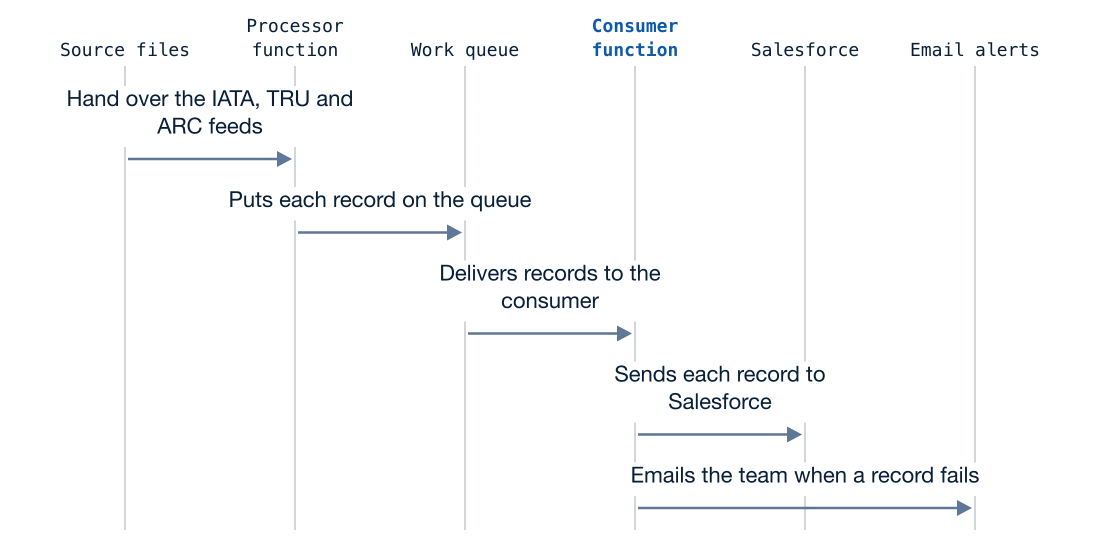
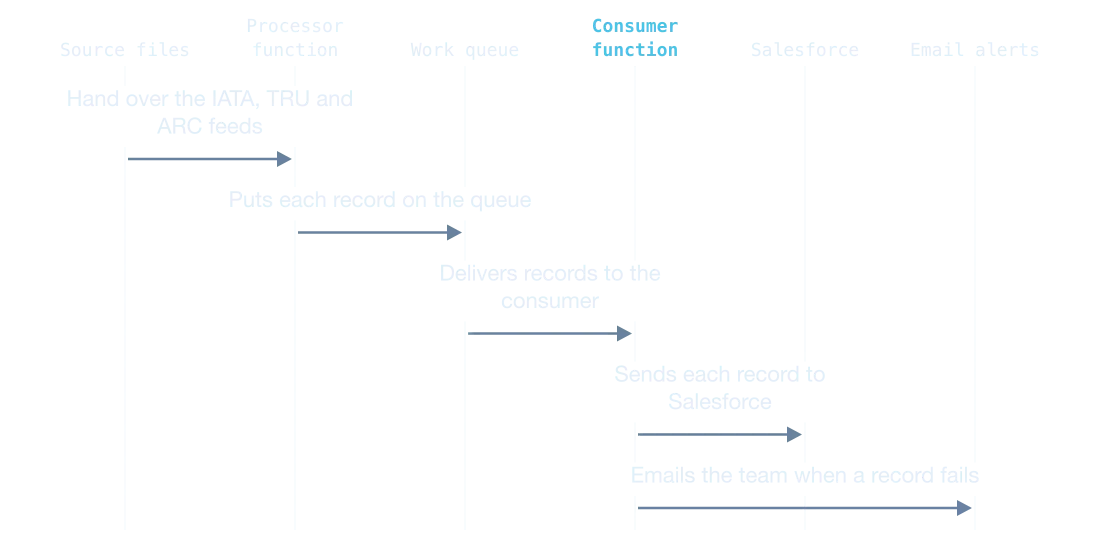
Two small serverless functions with a queue between them replace the single process. The flow above is a simplified illustration of that shape.
- Event-driven ingestion. Feed files land in AWS S3 and a function picks them up, instead of waiting for a scheduled batch window.
- A queue between the functions. The processor puts each record on an SQS queue and a consumer function sends it to Salesforce, so many workers can run concurrently and a failed record is retried without restarting the whole load.
- Alerts on failure. The consumer emails the team through AWS SNS when a record fails, instead of relying on someone noticing.
Trade-offs
- Concurrency against downstream limits. Fan-out through the queue makes processing fast, but the Salesforce API is the narrowest pipe, so concurrency has to be bounded to respect its limits.
- Two functions and a queue over one process. Splitting reading from sending adds a queue to operate, in exchange for independent scaling and retries.
- Serverless over a long-running batch service. There are no servers to size for peak loads, and costs follow volume. In exchange, the work has to fit Lambda’s execution model, so it is designed as small, idempotent units.
- Queues can deliver a message more than once, so record handling must be idempotent to avoid duplicate updates.
Measurable Impact
- Batch-processing bottlenecks were eliminated with an event-driven AWS Lambda and SQS pipeline.
- Millions of IATA, ARC and TRU records are ingested and reconciled with Salesforce.